An Interesting WW1 & WW2 Royal Navy/Merchant Navy, 'Muncaster Castle Sinking' Gallantry M.B.E. Medal Group to Third Officer Thomas Moodie (1602)
An Interesting WW1 & WW2 Royal Navy/Merchant Navy, 'Muncaster Castle Sinking' Gallantry M.B.E. Medal Group to Third Officer Thomas Moodie (1602)
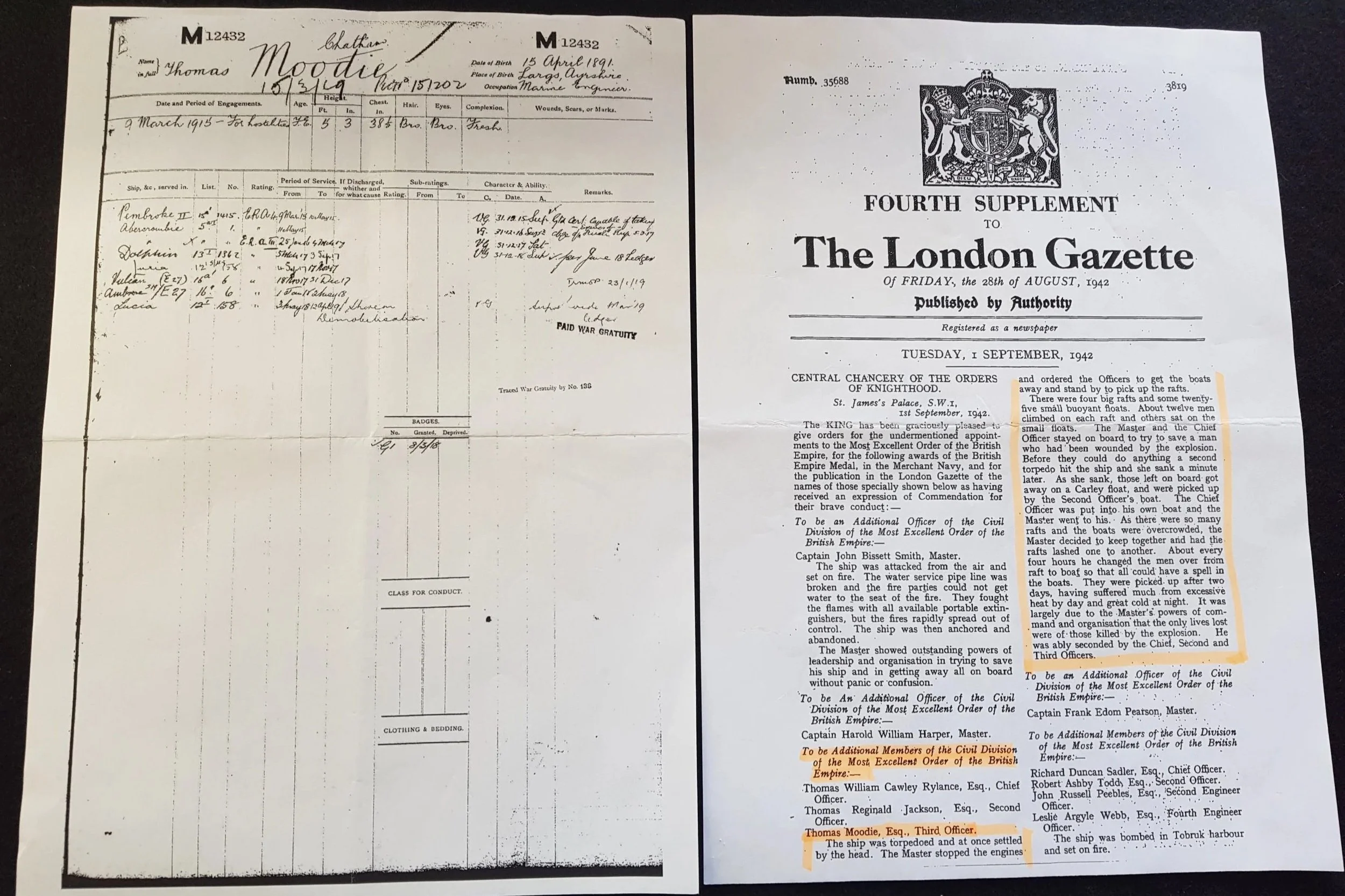
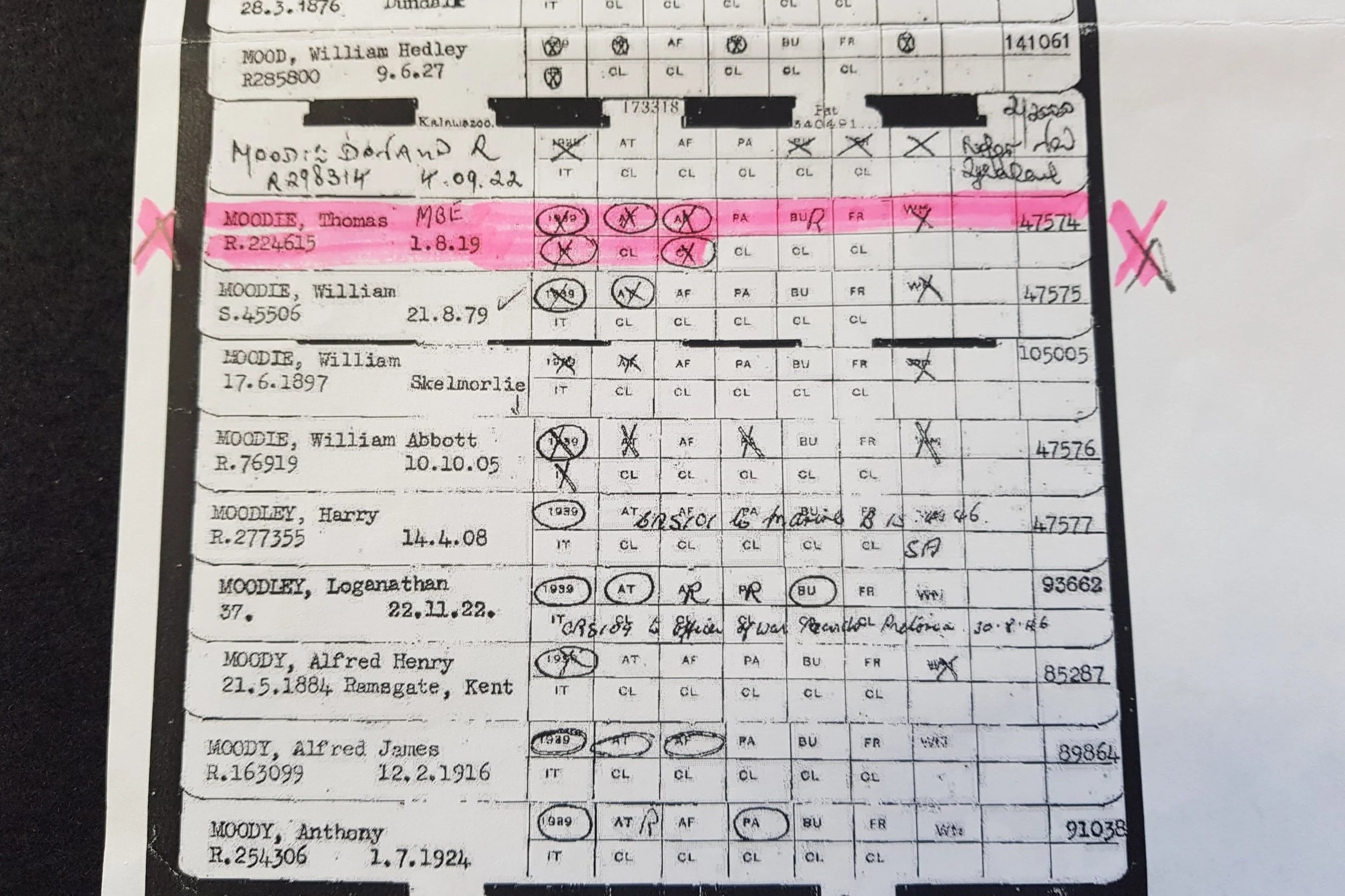
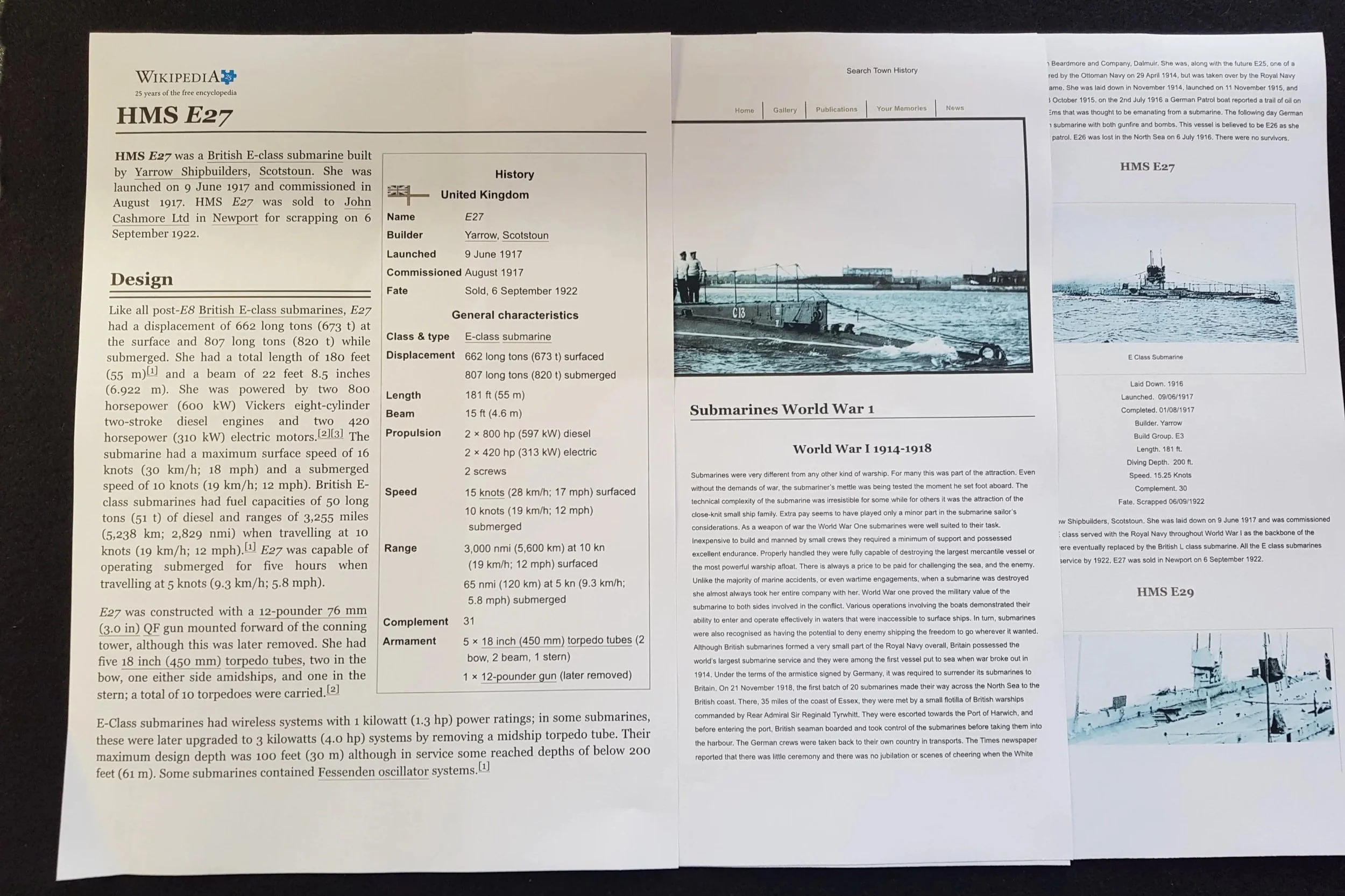
Thomas Moodie was born at Largs, Ayrshire on 15 April 1891. Working as a Marine Engineer on the outbreak of the Great War he enlisted as an Engine Room Artificer Class IV on 9 March 1915. Posted to the monitor Abercrombie, he saw action with her off Gallipoli, supporting Allied forces ashore. Joining the submarine training centre, Dolphin on 5 March 1917 he was posted to the submarine E27, serving with her from 12 May 1917. He was demobilised on 12 April 1919 and joined the Merchant Navy on 1 August 1919.
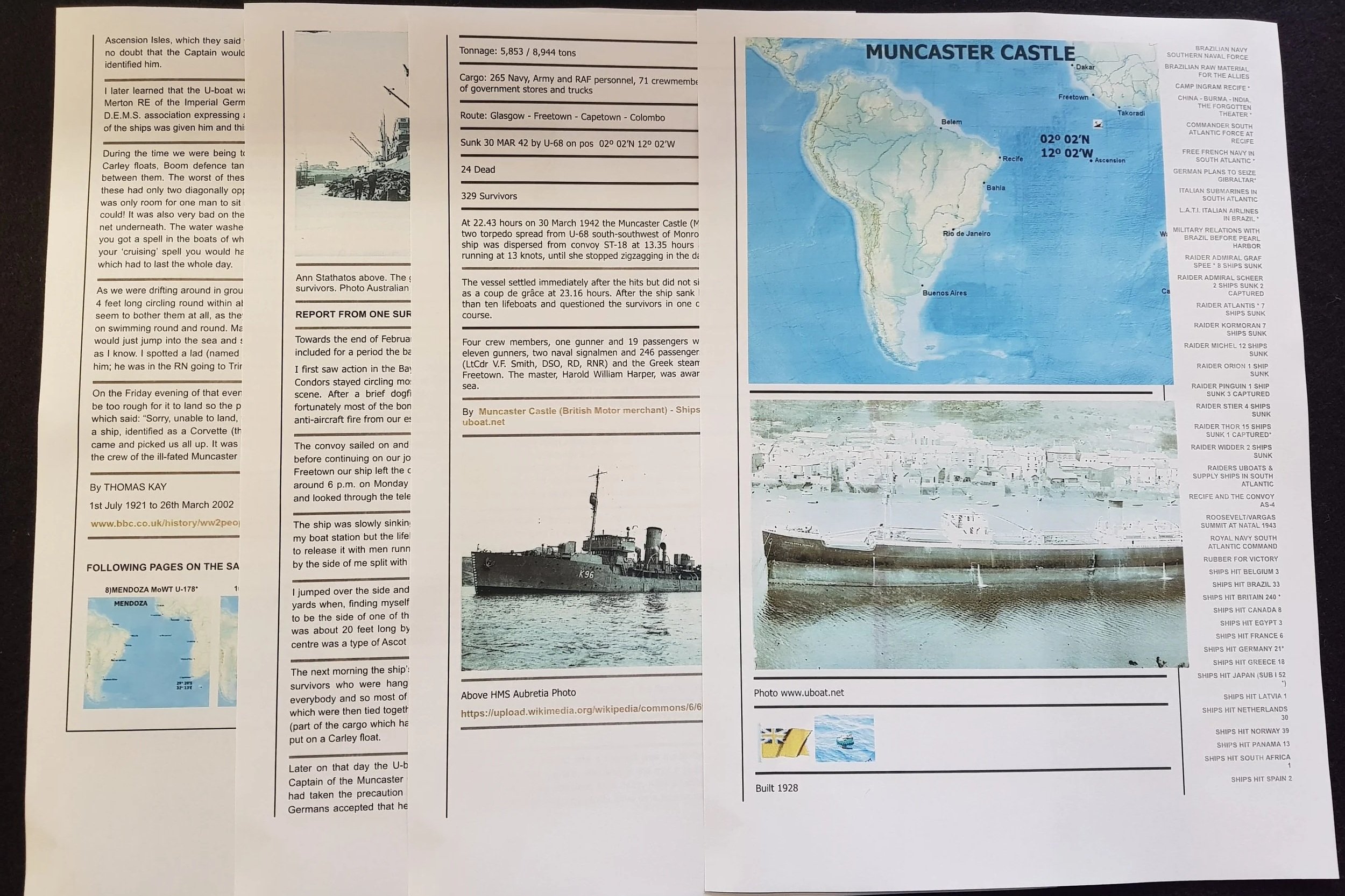
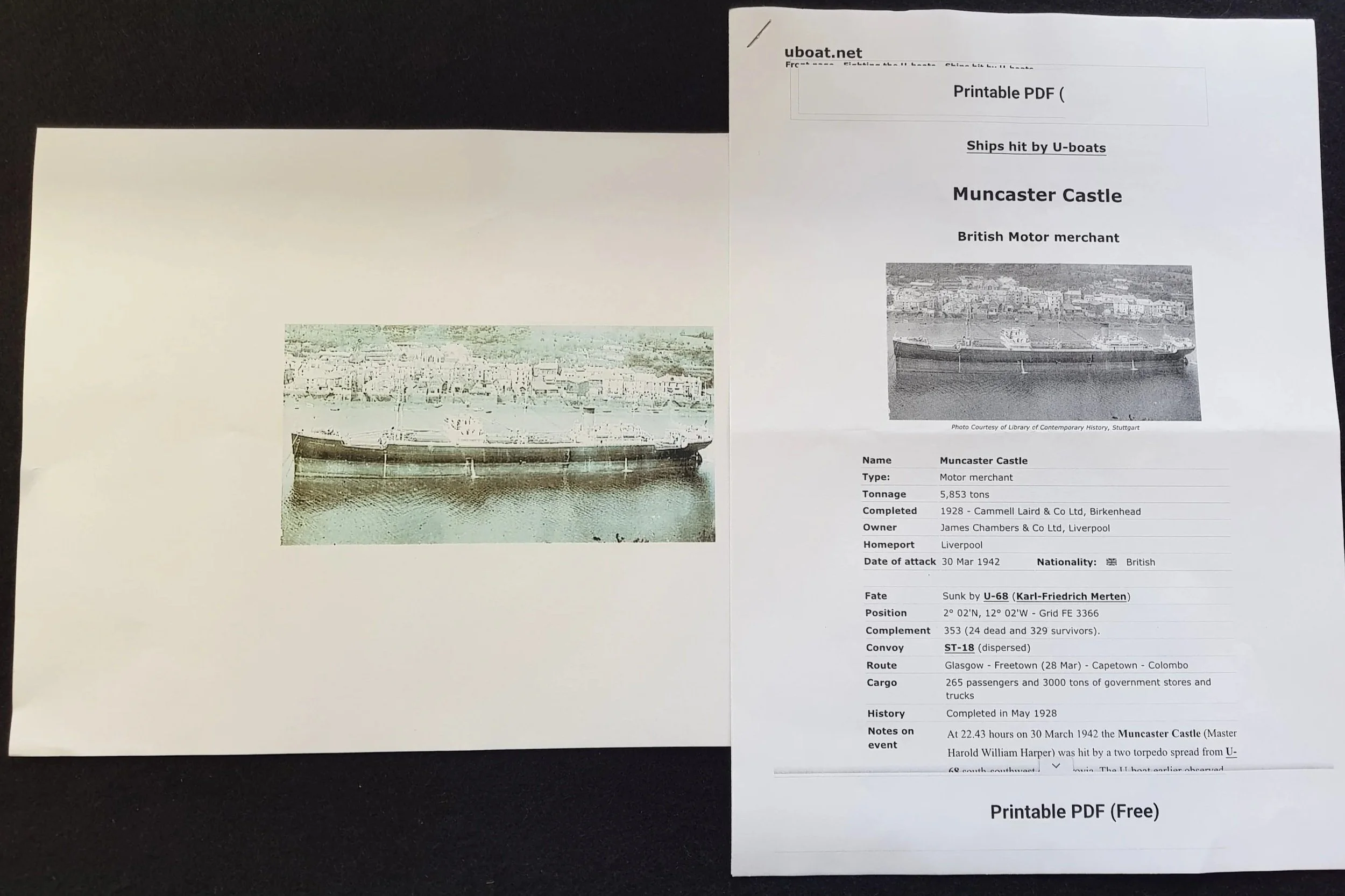
During WW2 he served as the 3rd Officer of the merchant vessel Muncaster Castle, when she was part of convoy ST-18 off Monrovia, West Africa. The Muncaster Castle contained 265 Army, Navy, and R.A.F personnel, 71 crew members, 12 DEMS gunners and 3000 tonnes of government stores. She separated late on 30 March 1942 from the main convoy and zigzagged at high speeds until night descended whereupon they slowed and resumed a straighter course. Unfortunately they were not alone, U-68 had been stalking them for some time and now seized upon their chance. At 22.43 Muncaster Castle was hit by a torpedoe and settled at once but did not sink and so U-68, circling their prey, fired another torpedo, finishing them off and nearly killing the heroic Ship's Master Harold Harper, who was in the act of saving a trapped crewman. Moodie was one of the senior officers praised for his careful handling of the situation which saw the majority of the more than 250 passengers survive the sinking. 24 personnel were killed.
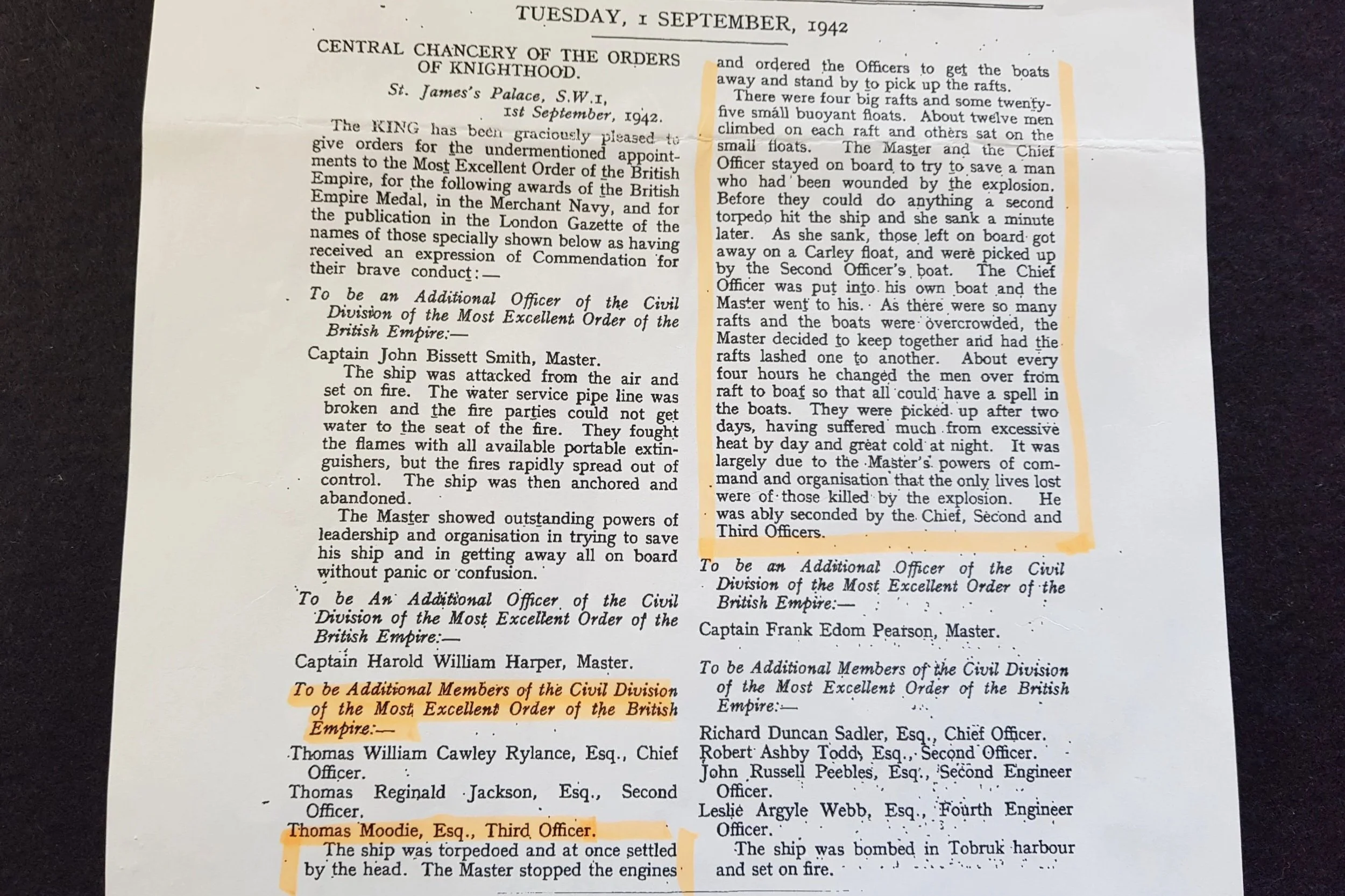
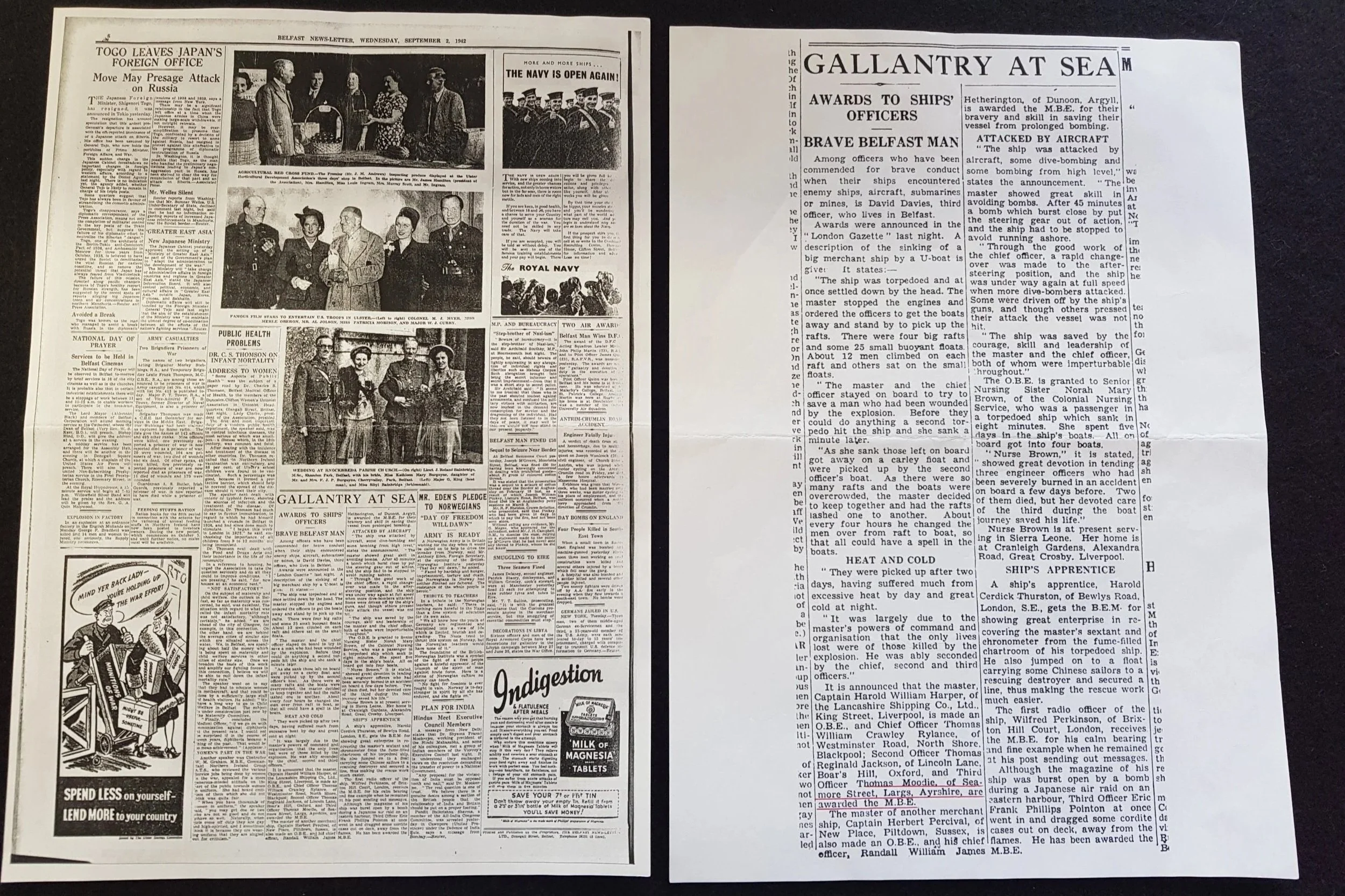
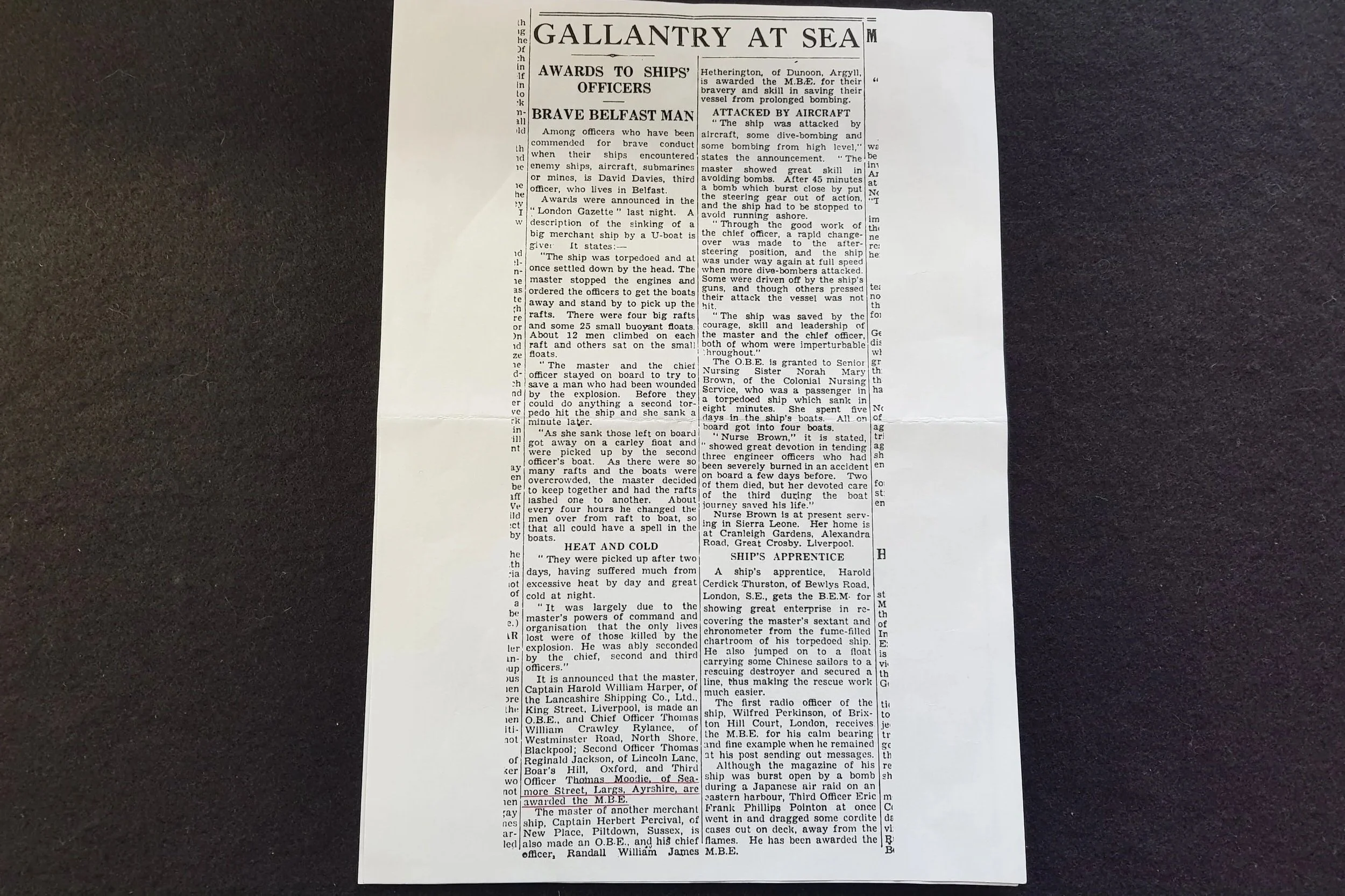
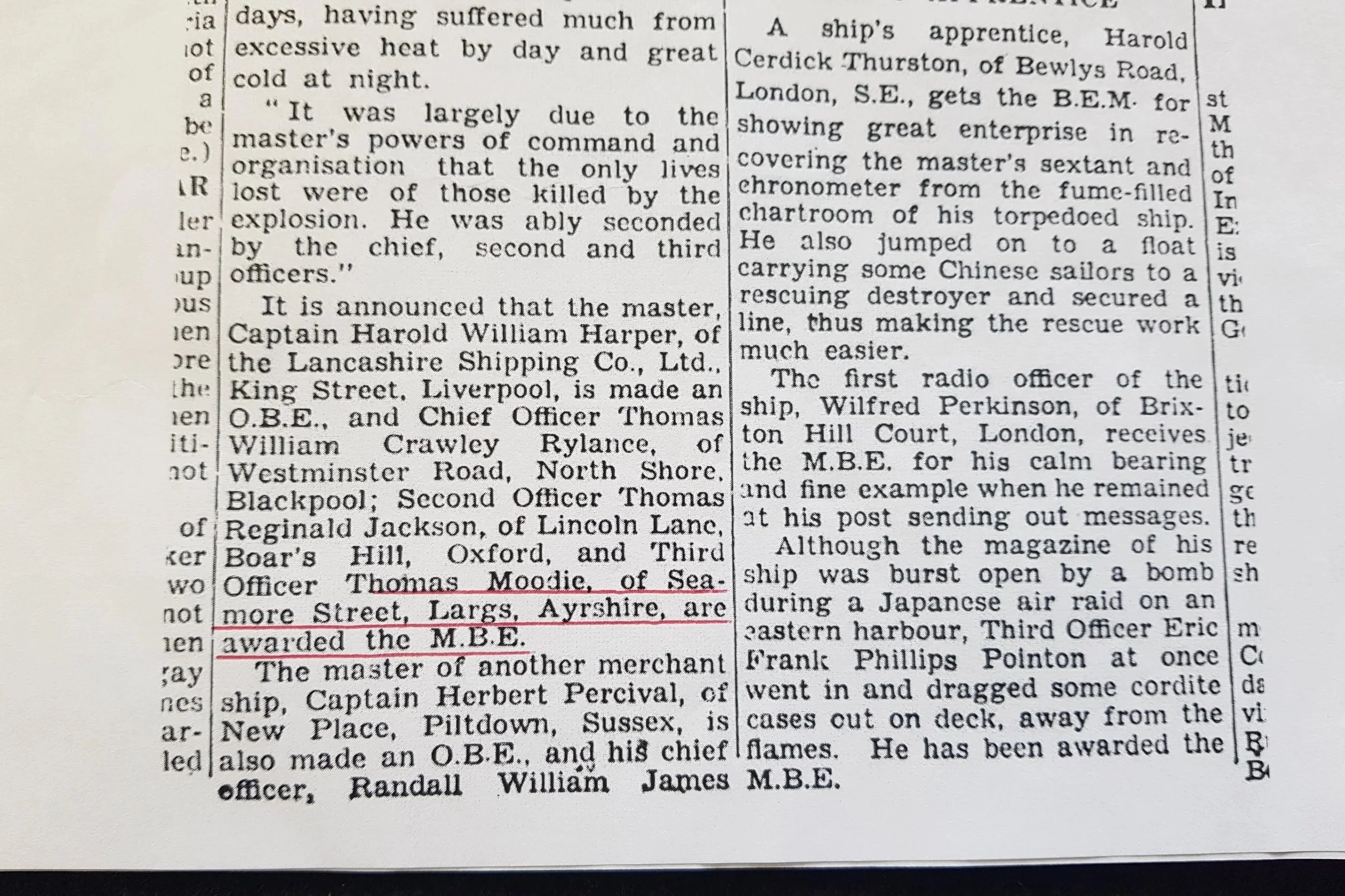
M.B.E. London Gazette 1 September 1942, the original group citation states:
'The ship was torpedoed and at once settled by the head. The Master stopped the engines and ordered the Officers to get the boats away and stand by to pick up the rafts.
There were four big rafts and some twenty-five small buoyant floats. About twelve men climbed on each raft and others sat on the small floats. The Master and the Chief Officer stayed on board to try to save a man who had been wounded by the explosion.
Before they could do anything a second torpedo hit the ship and she sank a minute later. As she sank, those left on board got away on a Carley float, and were picked up by the Second Officer's boat. The Chief Officer was put into his own boat and the Master went to his. As there were so many rafts and the boats were overcrowded, the Master decided to keep together and had the rafts lashed one to another. About every four hours he changed the men over from raft to boat so that all could have a spell in the boats. They were picked up after two days, having suffered much from excessive heat by day and great cold at night. It was largely due to the Master's powers of command and organisation that the only lives lost were of those killed by the explosion. was ably seconded by the Chief, Second and Third Officers.'
The below testimony is from one survivor, Thomas Kay -
“Towards the end of February 1942 we sailed as part of a large convoy, with a warship escort which included for a period the battleships HMS Rodney and HMS Nelson.
I first saw action in the Bay of Biscay when two FW 220 (Condor) aircraft bombed the convoy. The Condors stayed circling most of the day until one of our planes, a Catalina Flying boat, came on the scene. After a brief dogfight, the ‘Cat’ chased the Condors off. One ship was damaged but fortunately most of the bombs missed as the Condors had to bomb from a great height because the anti-aircraft fire from our escorts was so heavy.
The convoy sailed on and anchored in Freetown, North West Africa where we stayed a few days before continuing on our journey bound for Cape Town, South Africa. A day and a half after leaving Freetown our ship left the convoy and continued towards Cape Town on her own. Two days later, at around 6 p.m. on Monday 30th March 1942, a torpedo hit us midships. I ran to my gun, loaded it and looked through the telescope but couldn’t see anything as, by then, it was getting quite dark.
The ship was slowly sinking and you could hear the cries of the ratings in one of the holds. I went to my boat station but the lifeboat was tipped up and hanging by one 'fall down' near the water. I tried to release it with men running all around when another torpedo hit the ship midships and the deck by the side of me split with a great 2 foot wide crack.
I jumped over the side and swam off as the ship went down very quickly. I had swum for about 200 yards when, finding myself in the middle of floating debris, I clambered on to what I found out later to be the side of one of the troop galleys that had formerly been built on the deck. My new ‘boat’ was about 20 feet long by 8 feet wide covered in nails, which were sticking up all round. In the centre was a type of Ascot heater about 3 feet long to which I clung for the rest of the night.
The next morning the ship’s main motor boat, which had been got away, came round picking up the survivors who were hanging on to all sorts of floating objects. The motor boat couldn’t hold everybody and so most of the survivors were put on to the more seaworthy of the floating objects which were then tied together and taken in tow. There were rafts, Carley floats, Boom defence tanks (part of the cargo which had been blown out of the holds) and all sorts of other floating junk, I was put on a Carley float.
Later on that day the U-boat that had torpedoed us surfaced and a request was made for the Captain of the Muncaster Castle to identify himself. The Captain, who was in the motor boat and had taken the precaution of removing his rank identifying epaulets, kept mum. After a while the Germans accepted that he could not be easily identified and they kindly gave us a course for the Ascension Isles, which they said was 450 miles away, and let us go on our way unmolested. I have no doubt that the Captain would have been taken aboard the U-boat as a prisoner if they had identified him.
I later learned that the U-boat was the U. 68. under the command of Commander Karl-Friedrich Merton RE of the Imperial German Navy. During the 1980’s I heard that he had written to the D.E.M.S. association expressing a desire to contact the survivors of ships he had torpedoed. A list of the ships was given him and this included the MV Muncaster Castle. I did not take up his offer.
During the time we were being towed, we took turns to do six-hour spells on each of the crafts, Carley floats, Boom defence tanks or a raft. The motor boat was used to transfer each group between them. The worst of these spells were those spent on the Boom defence tanks because these had only two diagonally opposite large rings on an otherwise smooth sloping surface. There was only room for one man to sit inside each ring and everybody else had to hang on as best they could! It was also very bad on the Carley floats as you had to sit with your legs in the water with a net underneath. The water washed up and down your back when the float rocked. Once in a while you got a spell in the boats of which there were two, one lifeboat and the main motorboat. During your ‘cruising’ spell you would have the luxury of a ‘peg of water’ and a couple of hard biscuits which had to last the whole day.
As we were drifting around in groups on the rafts and Carley floats we could see small sharks about 4 feet long circling round within about 6 feet or so. I took a swipe at them a few times but it didn’t seem to bother them at all, as they would just roll over on their side, then roll back again and carry on swimming round and round. Matelots (a sailor) and soldiers who spotted mates on the other rafts would just jump into the sea and swim to each other but the sharks never touched anybody as far as I know. I spotted a lad (named Lawton) who lived in my street, I swam over and had a chat with him; he was in the RN going to Trincomalee.
On the Friday evening of that eventful week a Sunderland flying boat spotted us. The sea proved to be too rough for it to land so the pilot dropped a parachute with a few supplies in it and a message which said: “Sorry, unable to land, will send help as soon as possible”. The next morning we sighted a ship, identified as a Corvette (the Aubretia), which was looking for us. We let off flares and she came and picked us all up. It was very crowded seeing as there were around 250 passengers plus the crew of the ill-fated Muncaster Castle.”
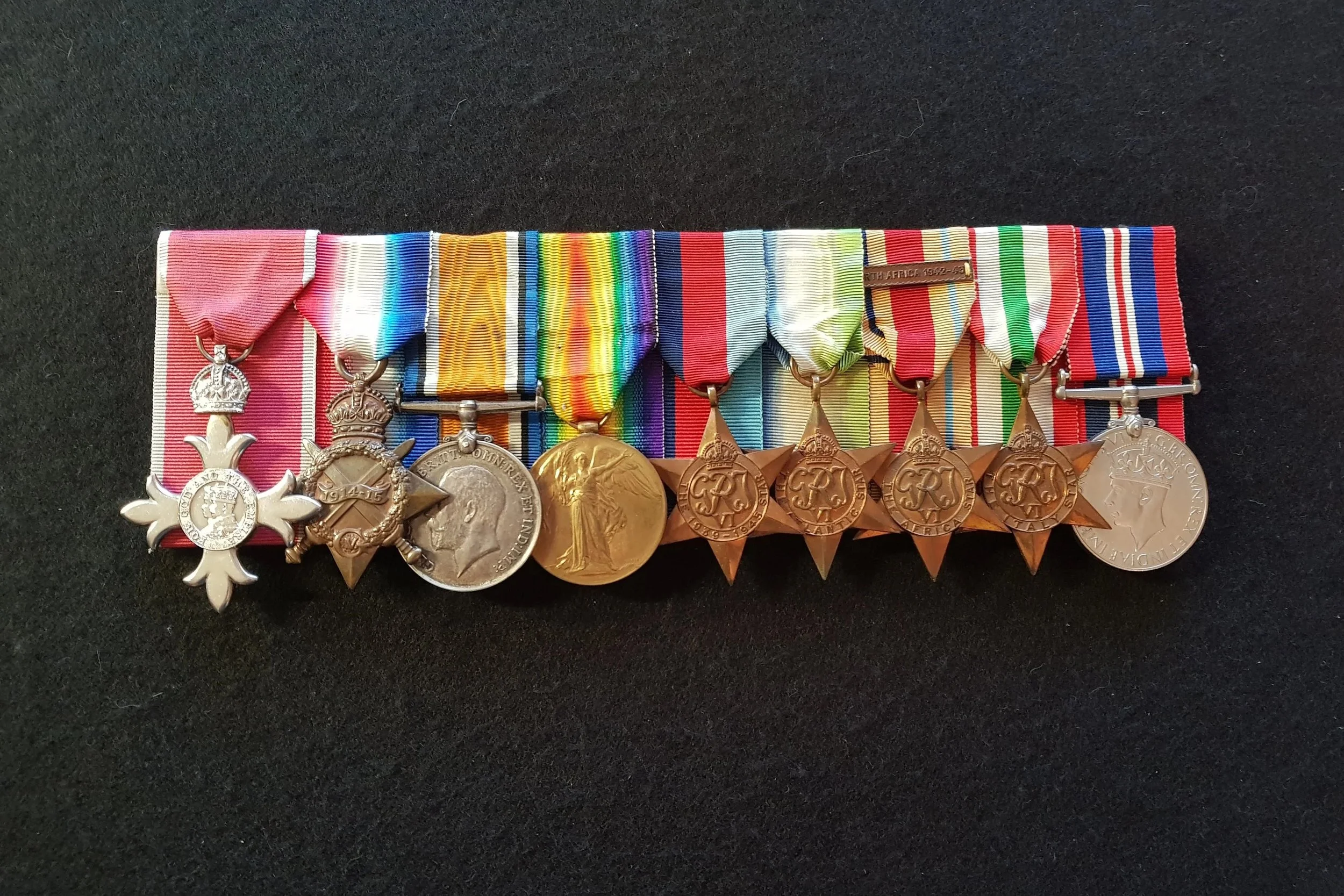
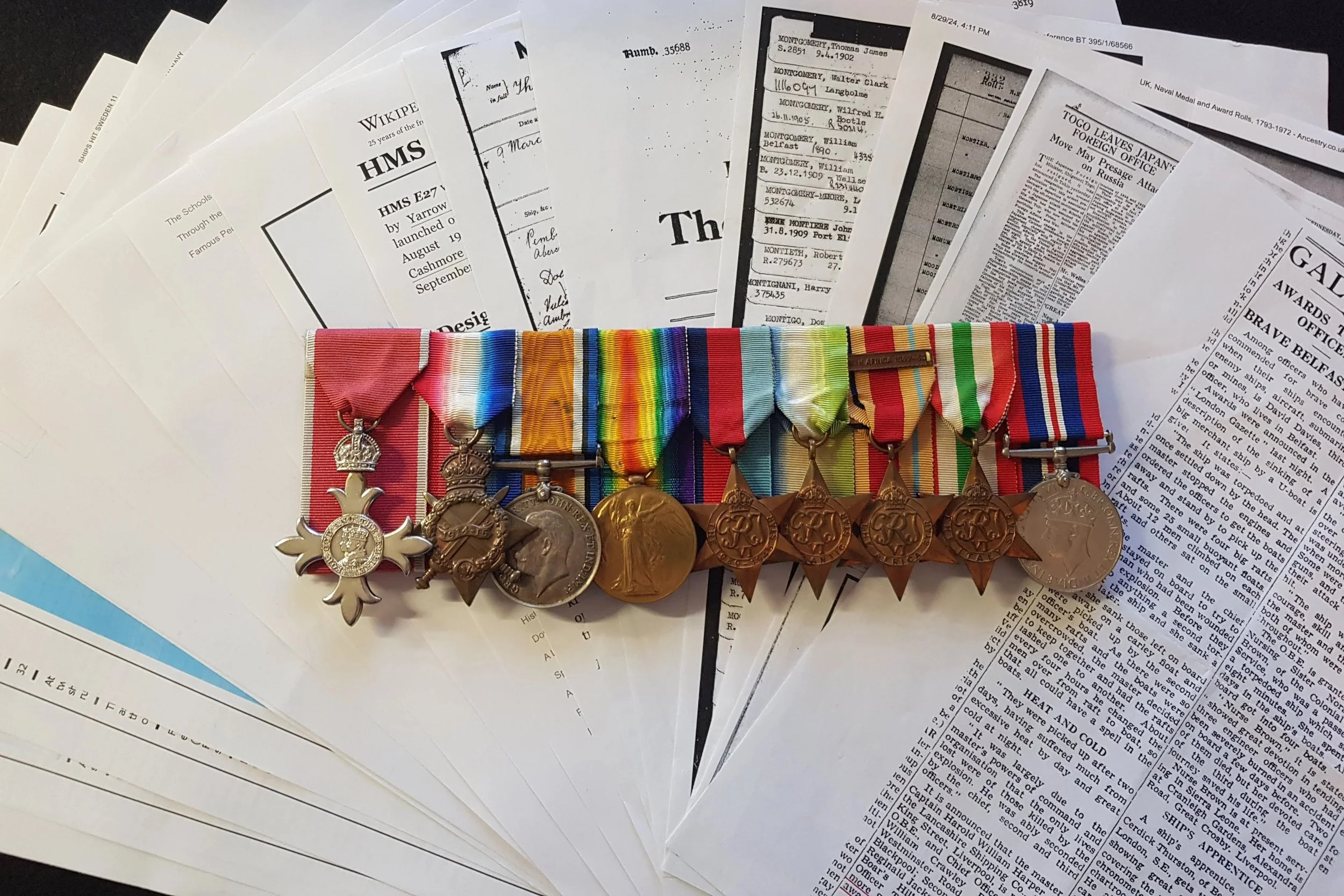
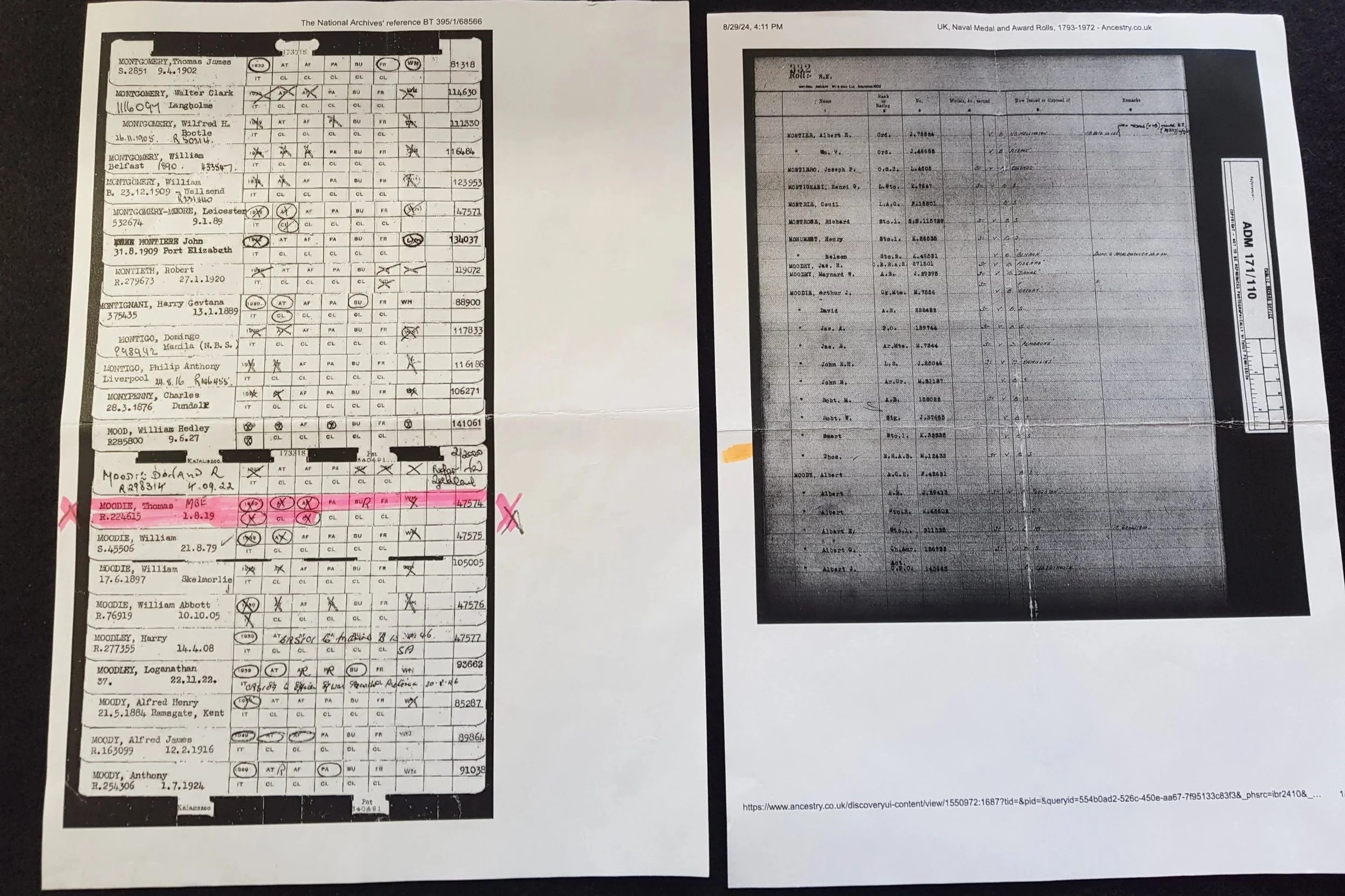
The medals are mounted for display, sold with copied research (including medal roll confirming all clasp and medal entitlement), and are as follows -
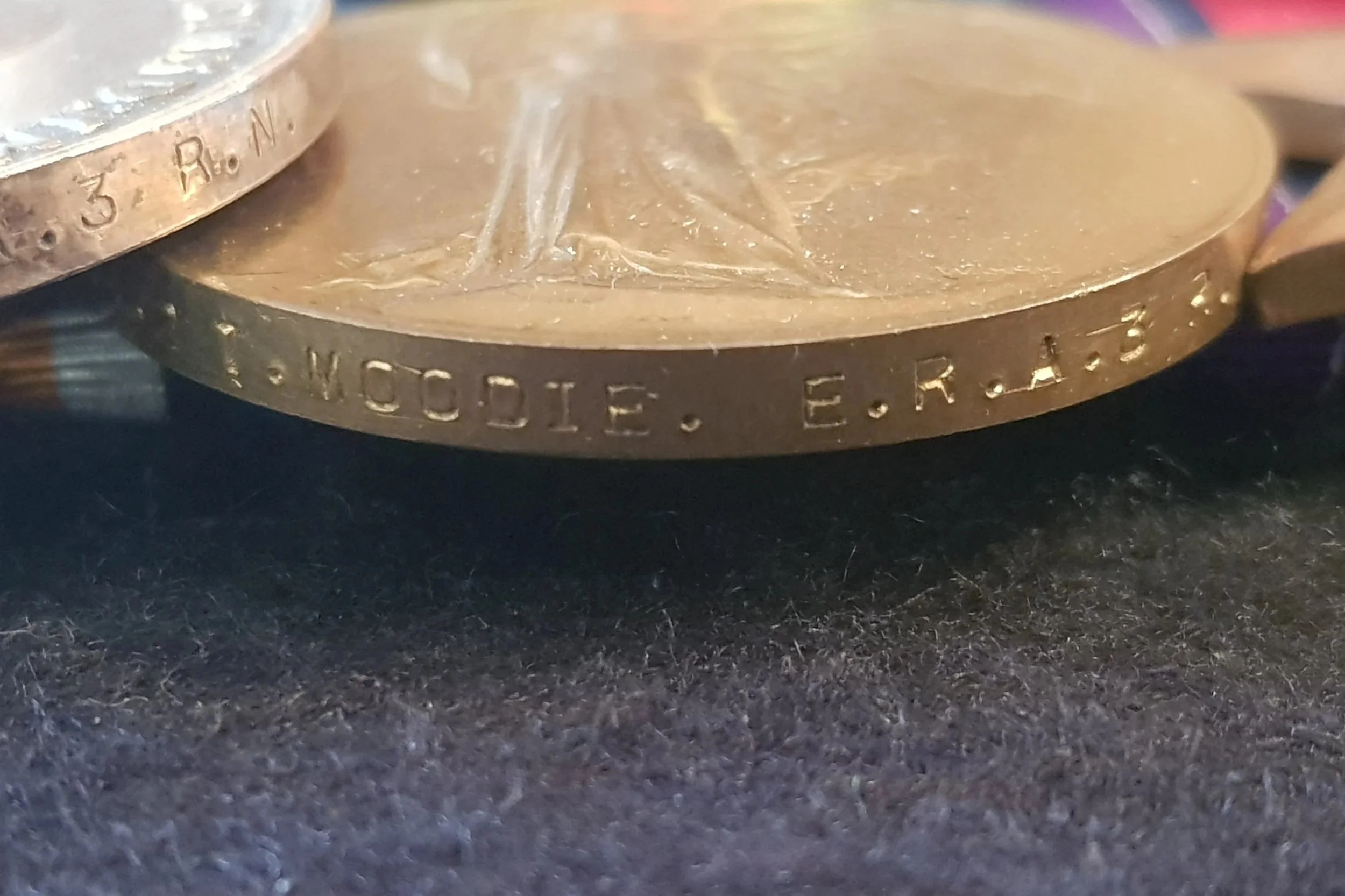
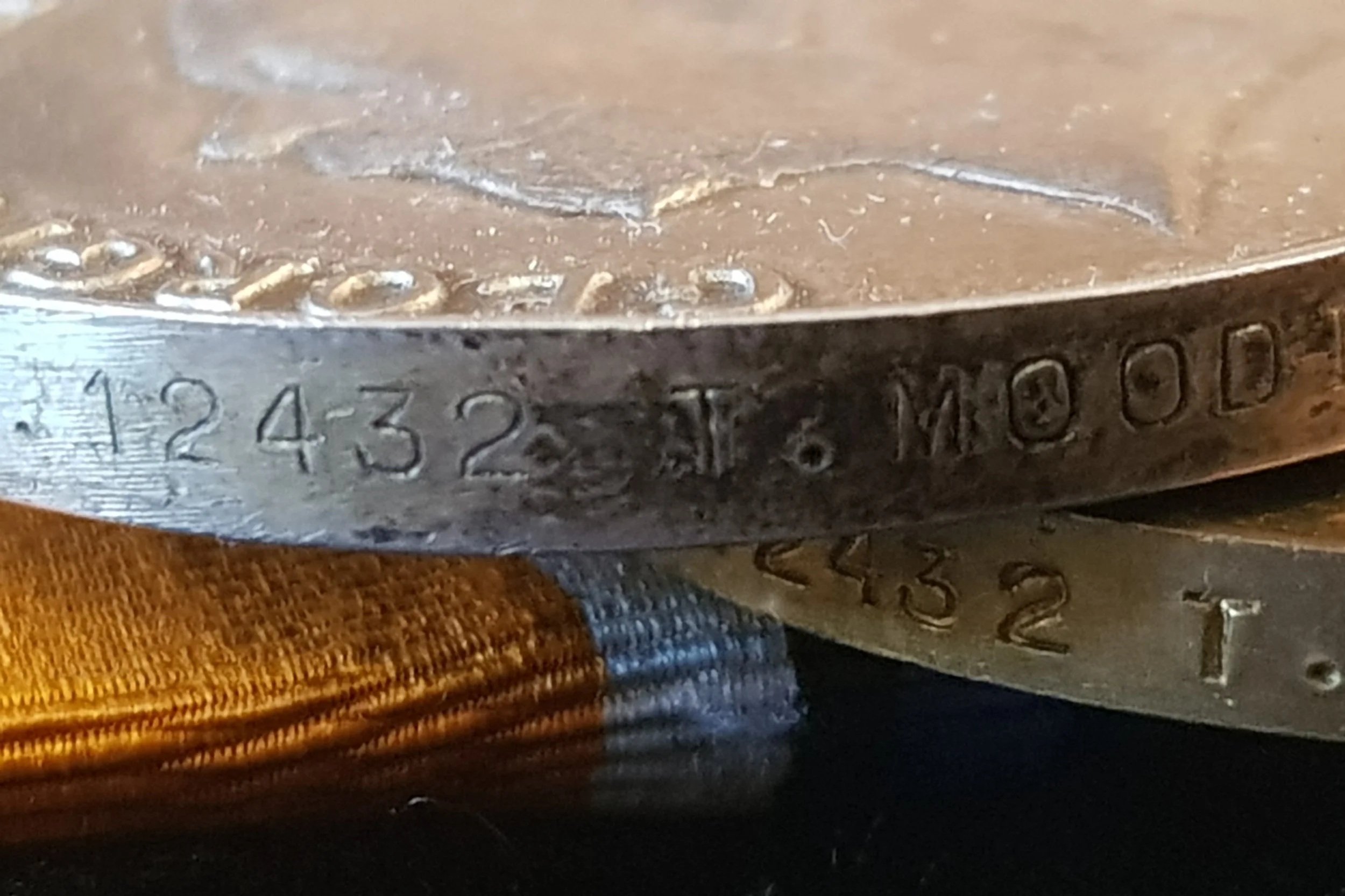
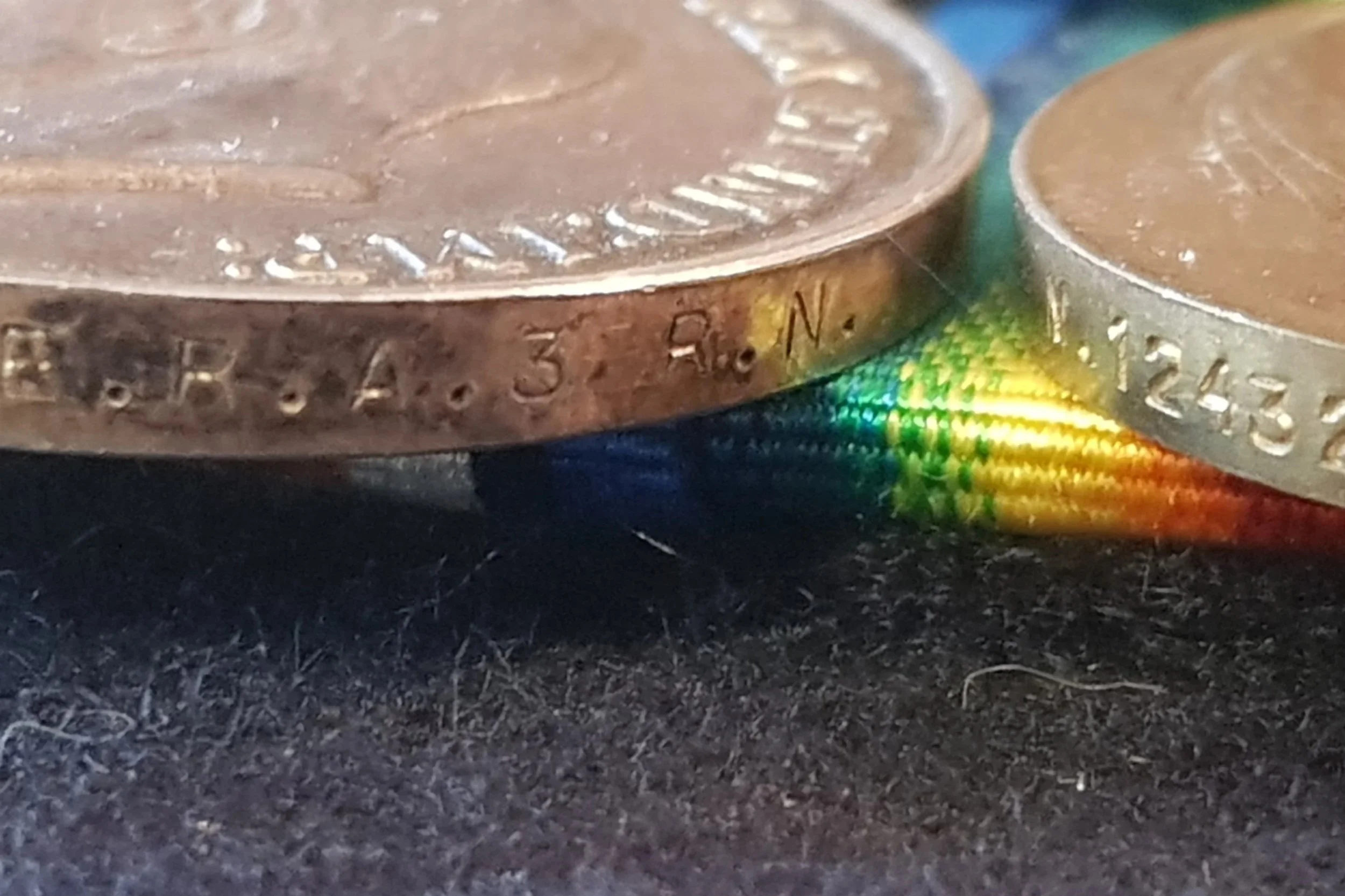
Order of the British Empire, Members Breast Badge (Civil Division), 2nd Type, unnamed as awarded; 1914-15 Star, M.12432. T. MOODIE. E.R.A.4, R.N.; British War and Victory Medals, M.12432 T. MOODIE. E.R.A. 3 R.N., the British War Medal officially renamed in a late-issue style; 1939-45 Star; Atlantic Star; Africa Star, clasp, North Africa 1942-42; Italy Star; War Medal 1939-45, all unnamed as issued.
Condition, good very fine